A post landed in my feed this morning from CNA, the Singaporean broadcaster. Verified account, four sentences, no link:
BREAKING: Jensen Huang has resigned as Nvidia CEO effective immediately. Colette Kress, current executive vice president and chief financial officer of Nvidia, has agreed to serve as interim CEO.
An hour after it went up it had 3,040 reactions and 1,646 shares. I checked it before believing it, and the result is worth writing down — not because the post was wrong, but because it was completely right and the story around it still is not.
What the filing actually says
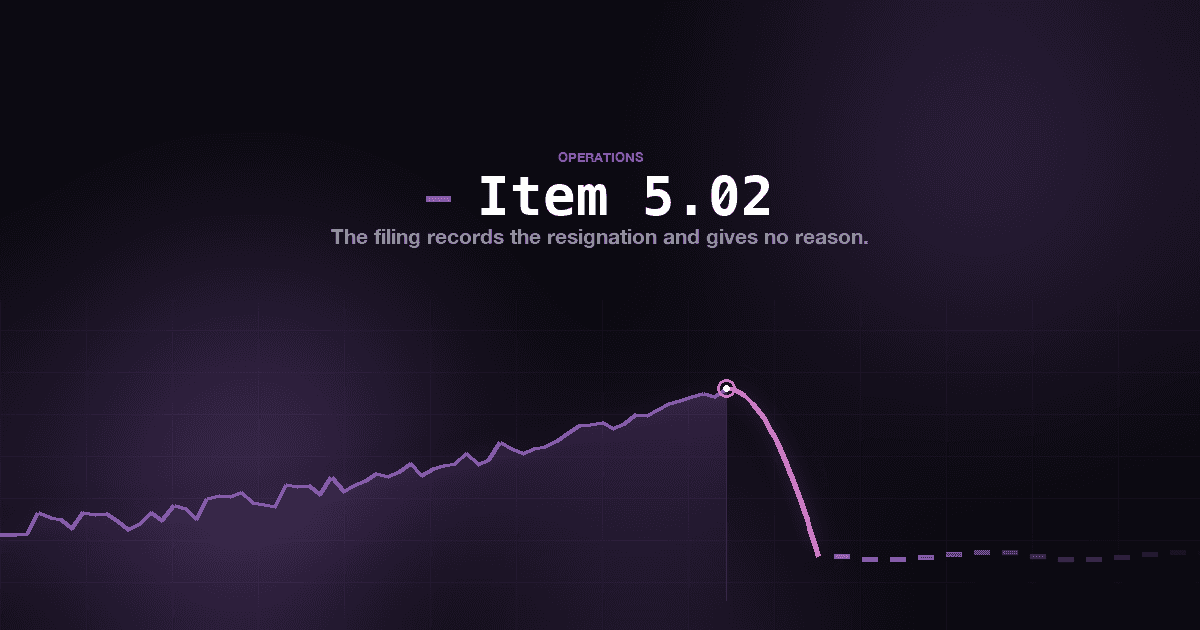
Every word of that post is accurate. NVIDIA filed a Form 8-K under Item 5.02 — the item a company files when an officer departs. The board accepted the resignation of Huang as president, chief executive officer and a member of the board, effective immediately. Kress, the CFO, becomes interim chief executive while staying CFO. The board named Harvey C. Jones as its first-ever chair and said it expects operations, customer commitments and the product roadmap to continue without interruption.
Two details from the primary source that the coverage mostly drops. The filing names him Jen-Hsun Huang, his legal name, not the Jensen of every headline — which matters if you ever go looking for it on EDGAR yourself. And the date of earliest event is the day before the announcement: the board accepted this on the 11th and told the market on the 12th.
He had led the company for 33 years, from its founding in 1993.
Here is the part that stopped me:
The 8-K gives no reason. None. It records that the board accepted a resignation and it stops. There is no "to pursue other interests", no "following a review", no gratitude paragraph doing quiet work. A filing that says nothing is saying something, but it is not saying why.
So where did the reason come from?
Not from NVIDIA. It came from two other places, and they are not the same quality of evidence.
The first is Huang himself. He told staff in an email that he had had an affair with a businesswoman, and that the board had opened an independent investigation. That is an admission by the person involved, reported by multiple outlets — strong, but it is reporting of a private email, not a document anyone can pull.
The second is the part doing most of the work in the retelling, and it is the weakest. The woman is said by intelligence agencies to be a Chinese spy, and is linked to a cloud company and NVIDIA customer accused of helping restricted Chinese firms obtain AI chips. That is an allegation under investigation. A committee of independent directors with outside counsel is still looking at it. China's foreign ministry has publicly called the spying claim unsubstantiated. Nobody has produced a finding.
So three things are circulating as one story, and they sit at three different confidence levels:
- Huang resigned and Kress is interim CEO — backed by a filed document. Anyone can pull it and check it.
- There was an affair — backed by his own email to staff, reported by journalists who saw it.
- The woman is a spy — backed by nothing concluded. An allegation, under investigation, publicly disputed.
The first is a fact. The second is sourced reporting. The third is an open question being repeated in the voice of the first.
Why does the difference matter if the headline was true anyway?
Because the inference is what people act on, and it is the part that can be wrong without the headline being wrong.
A missing reason and a bad reason are different facts, and the moment they produce the same confident sentence in someone's head, the difference is gone. If the investigation concludes there was no espionage, every forward of row three was wrong — and the person who forwarded it will remember reading it under a verified newsroom's byline, because that is where they saw it.
The market did not wait for the distinction. NVDA fell somewhere between 10% and 12% in premarket trading depending on which outlet you read and at what minute, and by 9:32 a.m. ET it traded 17.6% below its close of $186.64 six days earlier. At around $156 a share that is more than $1 trillion of market value gone, about 24.5%, since the start of the month — a figure from 24/7 Wall St, derived, not published by anyone at NVIDIA. I am attributing it rather than asserting it, for the same reason as everything else here.
The part that applies to a business with no ticker
Strip out the espionage and what is left is the oldest operational problem there is: one person left and the whole thing repriced.
That is key-person risk, and a trillion dollars is just what it looks like when the company is large enough to have a market cap. The structure is identical in a business with eight people and a van. One person holds the quotes in their head. One person knows which customer gets the early slot and why. One person does the billing, and when that person is on holiday the invoices go out late or not at all.
Nobody calls it key-person risk at that size. They call it being busy. It shows up as a quote nobody wrote down, a job nobody scheduled, an invoice nobody sent — and unlike NVIDIA, there is no interim CFO stepping in and no board statement promising continuity.
The fix is not a succession plan. It is getting the things that live in one person's memory into a system that does not have a bad week, so that the business keeps running on a day when somebody does not show up.
That is most of what I build, and it is the same instinct as checking the 8-K: write down what is actually true, where anyone can find it, instead of relying on somebody remembering it correctly later.
If you want to see where your own business depends on one person recalling something, start with the public-facing end — my website check is free and needs no signup, and it will tell you in a minute what a customer hits when they try to reach you.
Then, if it is useful, book the 30-minute Operations Audit. Also free, also no signup. I will map where work leaks in your business and tell you what to fix first, including when the answer is that you do not need me.